
WORK, ENERGY AND MOMENTUM
The Properties of Matter course explores the fundamental characteristics that define and distinguish materials, focusing on both physical and mechanical attributes. Key concepts include density, which explains why oil floats on water; pressure, as seen in how sharp knives cut more effectively due to higher pressure over smaller areas; and elasticity, which is crucial in designing springs and shock absorbers. The course also covers floatation using Archimedes’ Principle, which helps explain how ships float despite their massive weight. Additionally, it examines surface tension, observable when insects like mosquitoes walk on water, and viscosity, which influences the flow of engine oils in automobiles.
3. System of particles and center of mass
System of particles and center of mass
A system of particles is a collection of point‑mass objects whose motion you analyze together (for example, colliding bodies, fragments of an explosion, or planets in a cluster). The center of mass (COM) of such a system is a special point that represents the “average” position of all the mass and behaves like a single particle whose mass equals the total mass of the system.
Definition of center of mass
Center of mass (COM) is the point at which the entire mass of a system may be considered to be concentrated for analysing its motion. It is the point where the system balances if supported.
For a system of particles with masses at positions, the position vector of the center of mass is:
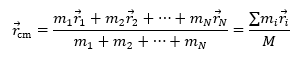
where is the total mass of the system.
In coordinates, this becomes:
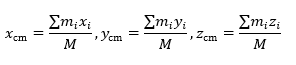
Note:
The center of mass is not the geometric center unless all masses are equal and symmetrically placed.
It is “weighted” by the masses: a heavier particle pulls the COM closer to itself.
The COM point moves as if all the mass of the system were concentrated there, and all external forces acted on that point.
- The total linear momentum of the system equals the momentum of a single particle of mass moving with the velocity of the COM: .
- For a body with symmetry (e.g., uniform sphere, cylinder, rectangular block), the COM lies at the geometric center or on the axis of symmetry.
Properties of center of mass
i. It is the balance point of a body or system
ii. It may lie inside or outside the body
iii. If no external force acts on the system, the center of mass moves with constant velocity.
Examples:
Two masses 2kg and 3kg are placed at positions 0 and 4m respectively. Determine the center of mass.
Three particles have masses 2kg, 5kg and 7 kg are located at 2m, 4m and 8m respectively. Find it center of mas.
Three particles are located at 2kg at (2,3), 3kg at (4, 5) and 5kg at (6,1). Find the coordinates of the center of mass.
A 4kg mass is 2m and unknown mass is 8m. If the center of mass is at 5m, find the unknown mass.
Motion of the center of mass
The motion of the center of mass (COM) describes how the average position of all the mass in a system change with time. Regardless of the interna motions of the particles, the center of mass moves as if all the mass of the system were concentrated at one point and all the external forces acted at that point.
If the net external force on the system is, then Newton’s second law for the COM is: 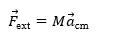
Where Fxt = external force
M = total mass of the system
acm = acceleration of the center of mass
This implies that Internal forces (between particles) do not affect the COM motion; they cancel in pairs by Newton’s third law.
Explosions, collisions, and internal rearrangements change the shapes and velocities of the parts, but the path of the COM is still governed by alone.
Example:
- A system has a total mass of 20kg. An external force of 100N acts on it . Find the acceleration of the center of mass.