NEWTON’S LAW OF GRAVITATION
2. Kepler's Law of Planetary Motion
Johannes Kepler formulated three empirical laws describing planetary motion.
First Law (Law of Orbits)
Every planet moves around the Sun in an elliptical orbit with the Sun occupying one focus.
Alternatively:
The orbit of each planet about the sun is an ellipse with the sun at one focus. The planet’s closest approach to the sun is called aphelion and its farthest distance from the sun is called perihelion.
Second Law (Law of Equal Areas)
A line joining the planet and the Sun sweeps out equal areas during equal intervals of time. This implies that Planet moves faster when closer to the Sun and Planet moves slower when farther away. This occurs because gravitational attraction becomes stronger when the planet is nearer to the Sun.
Third Law (Law of Periods)
The square of the orbital period is directly proportional to the cube of the semi-major axis.
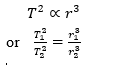
Where T = orbital period
r = orbital radius
uses of Kepler's Laws
- it is used for Satellite design
- use for Space exploration
- for Prediction of eclipses
- useful in Planetary motion
- for as Astronomy
Gravitational Potential Energy
Gravitational Potential Energy (GPE) is the energy possessed by an object because of its position in a gravitational field. 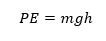
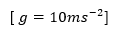
Near Earth's surface: g = 9.8ms-2
Example1: A 10 kg object is lifted through 20 m. Find the gravitational potential energy.
General Expression
Far from Earth's surface 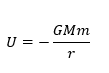
The negative sign indicates that gravitational force is attractive and work must be done to move the object infinitely far away.
Characteristics
- Depends on position placed
- Increases with height.
- Zero at infinity (by convention).
- Can be converted to kinetic energy.
Escape Velocity
Escape velocity is the minimum velocity required for an object to leave the gravitational field of a planet permanently without further propulsion. It does not depend on the mass of the escaping object and direction of launch (assuming no air resistance). it is expressed as: 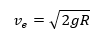
Escape Velocity contant = 11.2km/s
Factors Affecting Escape Velocity
- 1.Mass of the planet
- Radius of the planet
1. Find the escape velocity from a planet with a radius 6.4 x 10⁶m. Take