NEWTON’S LAW OF GRAVITATION
1. Introduction
Gravitational force
This is a natural force of attraction that exists between any two objects possessing mass. Every object in the universe attracts every other object, regardless of its size. Examples include; The Earth attracting objects towards its surface, Moon orbiting the Earth, Earth revolving around the Sun and artificial satellites orbiting the Earth.
Gravitational Field
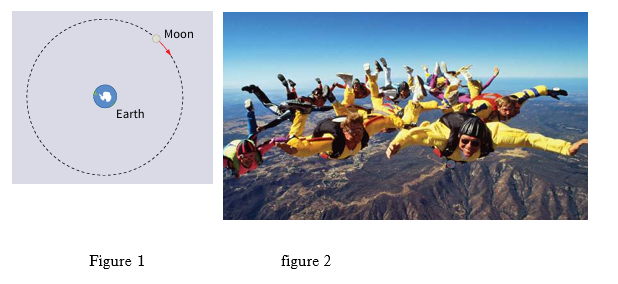
According to Newton, all masses create a gravitational field in the space around them. This field gives rise to a force on any object having mass which is placed in this field. The Moon orbits the Earth because it experiences a gravitational force due to the Earth’s gravitational field.
In physics, the idea of a field is a very general one. If an object is placed in a gravitational field, a force will act on the object because of its mass. For instance, a charged object experiences a force when it is placed in an electric field. You are probably familiar with the idea that a magnet produces a magnetic field around itself, and that this will produce a force (attractive or repulsive) on another magnet placed nearby. see figure 1 and 2 below:
Fundamental forces of nature
- Gravitational Force
- Electromagnetic Force
- Strong Nuclear Force
- Weak Nuclear Force
Although gravitational force is the weakest of these forces, it has an infinite range and dominates astronomical motions because celestial bodies possess enormous masses.
Newton's Law of Universal Gravitation
Newton used his ideas about mass and gravity to suggest a law of gravitation for two-point masses (Figure below). He considered two-point masses M and m separated by a distance r. Each point mass attracts the other with a force F. (According to Newton’s third law of motion, the point masses interact with each other and therefore exert equal but opposite forces on each other.) see figure 3.
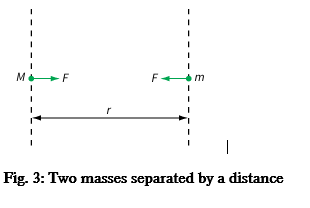
Sir Isaac Newton proposed that: Two-point masses attract each other with a force that is directly proportional to the product of their masses and inversely proportional to the square of their separation.
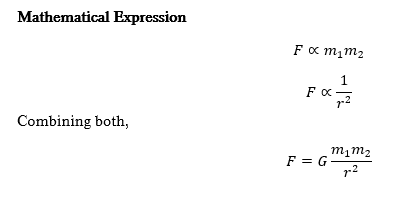
Where
F = gravitational force (N)
G = Universal Gravitational Constant
m₁ = first mass (kg)
m₂ = second mass (kg)
r = distance between their centres (m)
Characteristics of Gravitational Force
- Always attractive.
- Acts along the line joining the centres.
- Obeys the inverse square law.
- Acts over infinite distance.
- Depends on masses and separation.
EXAMPLE CALCULATION
1. Calculate the gravitational force of attraction between:
a) two objects separated by a distance of 1.0 cm and each having a mass of 100 g
b) two asteroids separated by a distance of 4.0 × 10⁹ m and each having a mass of 5.0 × 10¹⁰ kg
c) a satellite of mass 1.4 × 10⁴ kg orbiting the Earth at a distance of 6800 km from the Earth’s centre. (The mass of the Earth is 6.0 × 1024 kg).
2. Calculate the gravitational force between two masses of 20 kg and 40 kg separated by 5 m.
Gravitational Field Strength
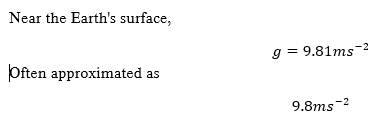
Definition: The gravitational field strength at a point is the gravitational force exerted per unit mass on a small object placed at that point. It has units of N kg−1 which is equivalent to ms−2. It is express as:
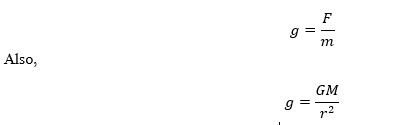
Where M = mass producing the field, r = distance from its centre