
The Concept of IEEE 802 Standard
The IEEE 802 standards are overview of networking operation through assuring compatibility, efficiency, and security among various wired and wireless networks.
1. The Concept of IEEE 802 Standard
The 802 Standards are a set of networking guidelines established by the Institute of Electrical and Electronics Engineers (IEEE) to describe the operation of various computer networks. The standards mainly address LANs and MANs, and they address aspects like wired and wireless communication, network infrastructure, and protocols. The IEEE is a standardizer of both wired and wireless networks. The 802 Standards for LANs and MANs define wireless networks exclusively for the first two layers of the OSI model, the Data-link and physical layers, which are also known as LLC and MAC as shown in Figure 2.3.
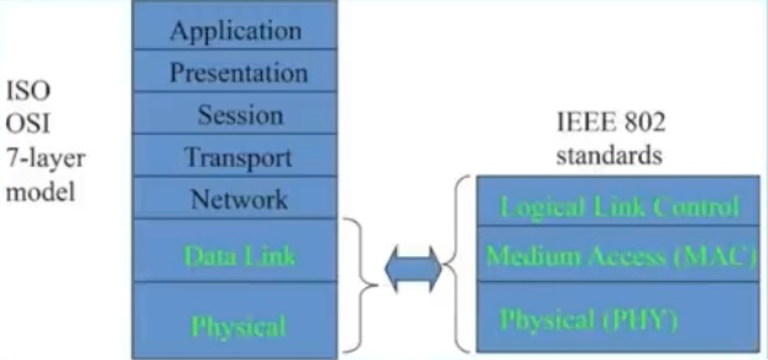
Figure 2.3: 802 Standard operation
Major IEEE 802 Standards and their Uses
1. IEEE 802.1-Network Architecture and Management: addresses management, security, bridging, and the overall design of networks. To improve network performance and security, many enterprise networks use virtual local area networks (VLANs). Essential parts of this kind of network standard include:
i. 802.1Q (VLANs) → describes virtual local area networks, which enable the partitioning of a single physical network into numerous logical networks
ii. 802.1X (Port-Based Network Access Control) → Authentication is required for access to networks (such as in corporate Wi-Fi).
iii. 802.1D (Spanning Tree Protocol - STP) → Stops Ethernet switching from creating loops in the network.
iv. 802.1AE (MACsec - Media Access Control Security) → Provides LAN traffic encryption.
2. IEEE 802.2- Logical Link Control (LLC): identifies the upper sublayer of the data link layer, which is in charge of flow regulation and error detection. Enables seamless device-to-device connectivity irrespective of the type of physical network. Assures dependable data transfer between network equipment. Operates above the Media Access Control (MAC) layer, which is where Ethernet and Wi-Fi and other 802 standards define it.
3. IEEE 802.3 – Ethernet (Wired LANs): Sets up Ethernet, the widely used standard for wired networking. Ethernet is utilized in residential, commercial, and data center environments for wired internet connectivity and internal networking. It encompasses various speeds and technologies, including: Evolution of Ethernet Speed:
• 10 Mbps (10BASE-T) — Initial Ethernet networks.
• 100 Mbps (Fast Ethernet, 100BASE-TX).
• 1 Gbps (Gigabit Ethernet, 1000BASE-T).
• 10 Gbps (10GBASE-T) — Rapid networking solution for corporations.
• 100 Gbps – 400 Gbps Ethernet → Utilized in data centers and high-performance computing.
4.
IEEE 802.11 – Wi-Fi (Wireless LANs): Specifies
wireless networking standards (Wi-Fi). Wi-Fi is utilized in residential
settings, workplaces, public hotspots, and industrial networks. Various
iterations enhance velocity, range, and efficacy.
Wi-Fi Standards:
|
Wi-Fi Standard |
Maximum Speed |
Frequency Band |
Key Component |
|
802.11a |
54 Mbps |
5 GHz |
Initial high-speed Wi-Fi |
|
802.11b |
11 Mbps |
2.4 GHz |
Initial consumer-oriented Wi-Fi |
|
802.11g |
54 Mbps |
2.4 GHz |
Enhanced velocity for residential use Wi-Fi |
|
802.11n |
600 Mbps |
2.4 & 5 GHz |
Multiple Input Multiple Output (MIMO) |
|
802.11ac |
6.9 Gbps |
5 GHz |
Enhanced velocity and extended range |
|
802.11ax (Wi-Fi 6) |
9.6 Gbps |
2.4 and 5 GHz |
Enhanced efficiency in congested networks |
5. IEEE 802.15-Wireless Personal Area Networks (WPANs): provide short-range wireless communication for individual devices. For music devices, use Bluetooth; for smart home automation, use Zigbee. Subcategories are:
• Bluetooth 802.15.1 → Wireless connectivity for smart devices, speakers, and headphones.
• 802.15.4 (Zigbee): Utilized in industrial sensors, IoT devices, and smart homes.
• 802.15.6 (Body Area Networks, or BANs): This protocol allows wearable medical devices to communicate wirelessly.
6. IEEE 802.16-WiMAX (Wireless Broadband): WiMAX (Worldwide Interoperability for Microwave Access) is a protocol that enables long-distance bandwidth wireless communication. 5G technology is replacing WiMAX, which was utilized to provide internet access in rural areas. Among these are:
• Utilized as a substitute for fiber or DSL broadband in rural locations;
• Compatible with 4G LTE for high-speed internet access;
• Offers fixed stations speeds of up to 1 Gbps.
7. IEEE 802.17 - Resilient Packet Ring (RPR): Enhances data transmission in metropolitan area networks (MANs). Utilized in fiber-optic networks for metropolitan areas. Utilizes multiple fiber optic rings for redundancy. In the event of a ring failure, traffic is automatically redirected to the other ring.
8. IEEE 802.22 - Wireless Regional Area Networks (WRANs): Utilizes unoccupied television broadcast spectrum ("white spaces") to deliver wireless broadband connectivity. Enhances internet connectivity for remote educational institutions, healthcare facilities, and commercial enterprises. Coverage extends to 100 kilometers (62 miles). Engineered to provide broadband access to rural and underdeveloped regions. Operates within low-frequency bands (54–862 MHz), enhancing coverage. Facilitates high-velocity backbone networks for urban areas.
The IEEE 802 Standard is summarized in the table below.
|
IEEE 802 Standard |
Technology |
Use |
|
802.1 |
Network Management |
VLANs, Security, Authentication |
|
802.2 |
Logical Link Control |
Reliable data transfer |
|
802.3 |
Ethernet |
Wired LANs, data centers, businesses |
|
802.11 |
Wi-Fi |
Wireless LANs for homes, offices, public hotspots |
|
802.15 |
WPAN (Bluetooth, Zigbee) |
Short range wireless for IoT, personal devices |
|
802.16 |
WiMAX |
Broadband wireless for rural and city areas |
|
802.17 |
Resilient Packet Ring |
High speed fiber networks for cities |
|
802.22 |
WRAN |
Internet via unused TV spectrum |