
TCP/IP Protocols
The TCP/IP Layers
In general terms, communications can be said to involve three agents: applications, computers, and networks. Examples of applications include file transfer and electronic mail. The applications that we are concerned with here are distributed applications that involve the exchange of data between two computer systems.
These applications, and others, execute on computers that can often support multiple simultaneous applications. Computers are connected to networks, and the data to be exchanged are transferred by the network from one computer to another. Thus, the transfer of data from one application to another involves first getting the data to the computer in which the application resides and then getting the data to the intended application within the computer. With these concepts in mind, we can organize the communication task into five relatively independent layers.
• Physical layer
• Network access layer
• Internet layer
• Host-to-host, or transport layer
• Application layer
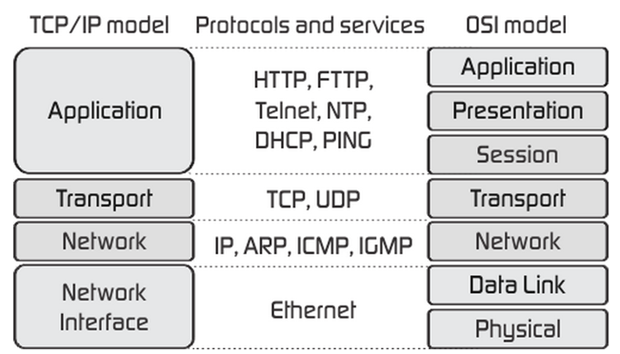
The physical layer covers the physical interface between a data transmission device (e.g., workstation, computer) and a transmission medium or network. This layer is concerned with specifying the characteristics of the transmission medium, the nature of the signals, the data rate, and related matters.
The network access layer is concerned with the exchange of data between an end system (server, workstation, etc.) and the network to which it is attached. The sending computer must provide the network with the address of the destination computer, so that the network may route the data to the appropriate destination. The sending computer may wish to invoke certain services, such as priority, that might be provided by the network. The specific software used at this layer depends on the type of network to be used; different standards have been developed for circuit switching, packet switching (e.g., frame relay), LANs (e.g., Ethernet), and others. Thus, it makes sense to separate those functions having to do with network access into a separate layer. By doing this, the remainder of the communications software, above the network access layer, need not be concerned about the specifics of the network to be used. The same higher-layer software should function properly regardless of the particular network to which the computer is attached.
The network access layer is concerned with access to and routing data across a network for two end systems attached to the same network. In those cases where two devices are attached to different networks, procedures are needed to allow data to traverse multiple interconnected networks. This is the function of the internet layer. The Internet Protocol (IP) is used at this layer to provide the routing function across multiple networks. This protocol is implemented not only in the end systems but also in routers. A router is a processor that connects two networks and whose primary function is to relay data from one network to the other on its route from the source to the destination end system.
Regardless of the nature of the applications that are exchanging data, there is usually a requirement that data be exchanged reliably. That is, we would like to be assured that all of the data arrive at the destination application and that the data arrive in the same order in which they were sent. As we shall see, the mechanisms for providing reliability are essentially independent of the nature of the applications. Thus, it makes sense to collect those mechanisms in a common layer shared by all applications; this is referred to as the host-to-host layer, or transport layer. The Transmission Control Protocol (TCP) is the most commonly used protocol to provide this functionality.
Finally, the application layer contains the logic needed to support the various user applications. For each different type of application, such as file transfer, a separate module is needed that is peculiar to that application.