
Lecture Notes on Male and Female Reproductive Physiology
Completion requirements
4. Ovarian and Menstrual cycles
4.1. Ovarian Cycle (28-Day Cycle)
1.1 Overview
§ The monthly series of events associated with egg maturation is the ovarian cycle.
§ It consists of three phases.
1. The follicular phase
2. Ovulation phase.
3. Luteal Phase
§ Regulated by the hypothalamic–pituitary–ovarian (HPO) axis.
§ Ovarian cycles may vary in length. Average length: 28 days (normal range: 21–35 days).
o The follicular phase may range from seven to 26 days long. However, the luteal phase is constant 14 days.
1.2 Follicular Phase (Day 1–14)
- Begins with menstruation.
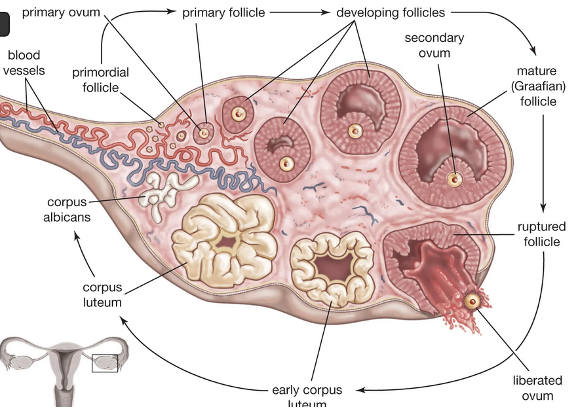
- Rising FSH stimulates a cohort of primordial follicles to develop into primary follicles.
- Continued follicular growth results in fused vesicles to form a single antrum. This is a mature Graafian follicle
- As the Graafian follicle grows, the primary oocyte finishes meiosis I to become a secondary oocyte (plus a polar body, which soon degenerates).
- Dominant follicle selected by Day 7.
- Granulosa cells produce estrogen.
- Endometrial proliferation
- Cervical mucus thinning
- Estrogen peak → LH surge (positive feedback)→ ovulation.
- The follicles that did not rupture degenerate and their eggs are lost.
1.3 Ovulation (Around Day 14)
- The spike in LH causes ovulation: the most mature follicle bulges out of the ovary, ruptures and releases its egg (secondary oocyte arrested in metaphase II).
- LH surge begins ~24 hours before ovulation.
- Stimulates Graafian follicle to rupture, releasing secondary oocyte
- Fertilization must occur within 12–24 hours.
- If not fertilized, the oocyte will degenerate after a few days.
1.4 Luteal Phase (Day 15–28)
- Ruptured follicle → corpus luteum under the influence of LH
- Secretes progesterone (dominant) + estrogen.
- The progesterone facilitates the regrowth of the uterine lining and inhibits the release of further FSH and LH.
- The inhibition of FSH and LH prevents any further eggs and follicles from developing, while the progesterone is elevated.
- If no pregnancy: corpus luteum degenerates → corpus albicans →hormonal level falls → menstruation begins.
- The decrease in progesterone also allows the hypothalamus to send GnRH to the anterior pituitary, releasing FSH and LH and starting the cycles again.
- If the oocyte is fertilized and pregnancy occurs, the corpus luteum will persist for about three months until the placenta is formed and ready to take over its function