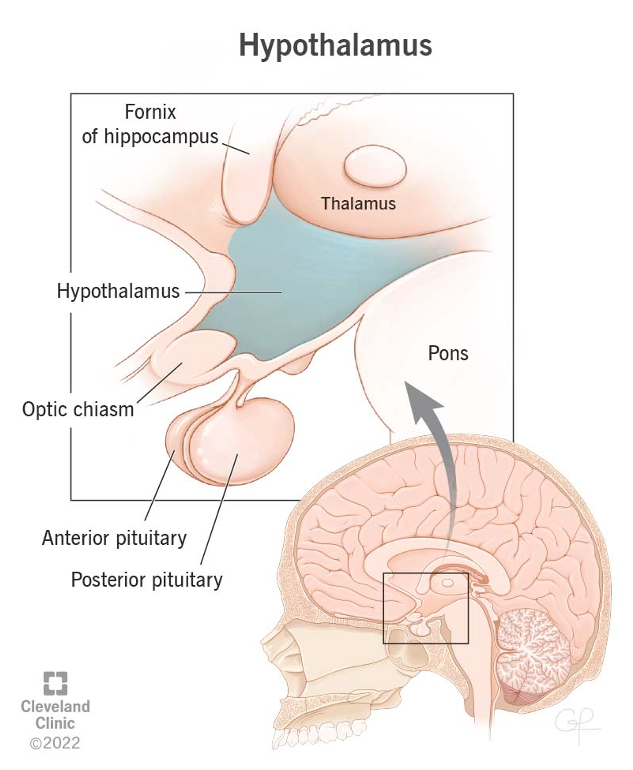
Hypothalamus and Pituitary Gland
Completion requirements
Learning Objectives:
- Describe the location and anatomy of the hypothalamus and pituitary.
- Explain the functional relationship between the two structures.
1. Introduction to the Hypothalamus
- The hypothalamus is a small but critically important part of the brain that plays a central role in maintaining homeostasis by integrating autonomic, endocrine, and behavioral responses.
- Despite its small size (about 4 g), it influences nearly every system in the body, including temperature regulation, hunger, thirst, sleep–wake cycles, emotional behavior, and hormonal secretion via the pituitary gland.
Location and Anatomical Boundaries
The hypothalamus is located below the thalamus and forms the floor and part of the walls of the third ventricle.
- Superior (Above): Thalamus
- Inferior (Below): Extends to the base of the brain; bounded by the optic chiasm, infundibulum, and mammillary bodies
- Anterior: Optic chiasm and lamina terminalis
- Posterior: Midbrain tegmentum
- Lateral: Internal capsule and subthalamic region
- Medial: Third ventricle
Surface landmarks:
- Optic chiasm: Anterior to the hypothalamus
- Infundibulum (pituitary stalk): Connects hypothalamus to pituitary gland
- Mammillary bodies: Paired rounded structures marking the posterior limi
Subdivisions of the Hypothalamus
For descriptive purposes, the hypothalamus is divided into three anteroposterior regions and three mediolateral zones:
A. Anteroposterior Regions
1. Anterior (Chiasmatic) Region:
- Located above the optic chiasm
- Includes the supraoptic, paraventricular, preoptic, and suprachiasmatic nuclei
2. Tuberal (Middle) Region:
- Located above the tuber cinereum and infundibulum
- Includes the arcuate, ventromedial, and dorsomedial nuclei
3. Posterior (Mammillary) Region:
- Located above and behind the mammillary bodies
- Includes the posterior nucleus and mammillary nuclei
B. Mediolateral Zones
- Periventricular Zone: Thin strip along the third ventricle; contains neurons regulating endocrine functions
- Medial Zone: Contains most hypothalamic nuclei; involved in integrating autonomic and endocrine responses
- Lateral Zone: Contains medial forebrain bundle and scattered nuclei; involved in feeding and arousal